Getting humidity right in your terrarium isn’t just important—it’s absolutely critical. I’ve watched countless beautiful terrariums turn into soggy disasters or crispy wastelands simply because of moisture management. After years of fine-tuning humidity across dozens of different terrarium setups, I can tell you that mastering this skill will make the difference between a thriving miniature ecosystem and a collection of expensive plant casualties.
The good news? Once you understand the principles and warning signs, humidity control becomes second nature. Let’s dive into everything you need to know about creating the perfect moisture environment for your plants.
Understanding Terrarium Humidity Requirements
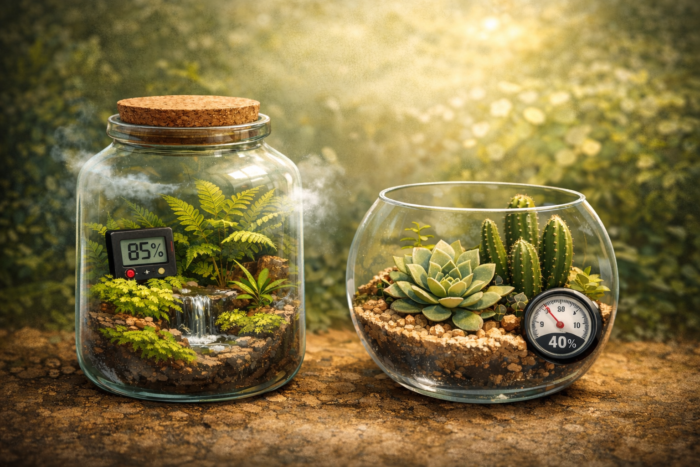
Different plants have vastly different humidity needs, and your terrarium type dramatically affects moisture levels. Closed terrariums naturally maintain 80-95% humidity—perfect for tropical plants like Fittonia nerve plants and most ferns. Open terrariums typically sit around 40-60% humidity, ideal for succulents and cacti.
Tropical plants from rainforest environments need consistent high humidity (70-90%) because their leaves have evolved thin cuticles that lose water rapidly. Succulent plants from arid regions prefer low humidity (30-50%) and can actually develop fungal problems in overly moist conditions.
Signs Your Terrarium Has Too Much or Too Little Humidity
Excessive Humidity Symptoms:
- Constant condensation that never clears
- Black, mushy stems or roots (root rot)
- White, fuzzy growth on soil or plants (mould)
- Yellowing leaves that drop easily
- Sluggish plant growth despite good light
- Foul, swamp-like odours
Insufficient Humidity Symptoms:
- Brown, crispy leaf edges (especially on ferns)
- Leaves curling inward to conserve moisture
- Stunted growth and small leaf size
- Frequent wilting despite adequate watering
- Moss turning brown and brittle
- Soil pulling away from container edges
The key is learning to read these signals early. I’ve found that healthy terrariums show light condensation in the morning that clears by midday—this indicates perfect humidity balance.
Tools and Techniques for Controlling Moisture Levels
A quality hygrometer is your best friend for terrarium humidity control. Digital versions with probe sensors give accurate readings—aim for models that display both current and min/max humidity over time. Place the sensor at plant level, not against the glass where readings can be skewed.
Increasing Humidity:
For open terrariums needing more moisture, try these techniques:
- Add a shallow water dish filled with pebbles
- Mist with a fine-mist spray bottle 2-3 times weekly
- Group plants together to create microclimates
- Use living sphagnum moss as a natural humidifier
Decreasing Humidity:
For overly moist environments:
- Remove the lid for 2-4 hours daily
- Improve drainage with LECA clay balls
- Add activated charcoal to prevent bacterial growth
- Position near gentle air circulation (not direct fans)
- Reduce watering frequency
I’ve found that gradual adjustments work best. Sudden humidity changes shock plants more than the original problem.
Ventilation Solutions for Different Terrarium Types
Closed Terrariums:
These sealed environments need strategic ventilation to prevent stagnation. Create controlled air exchange by:
- Lifting the lid slightly (2-5mm gap) during humid weather
- Installing tiny ventilation holes in the lid using a drill
- Using partially open containers like apothecary jars with loose-fitting lids
Open Terrariums:
While naturally ventilated, these can still develop stagnant air pockets. Improve circulation by:
- Positioning away from walls and corners
- Ensuring adequate spacing between plants
- Avoiding overcrowding with decorative elements
- Using taller containers that promote air movement
Semi-Open Designs:
Containers with partial openings offer excellent humidity control flexibility. Geometric glass terrariums with hinged doors or removable panels allow you to fine-tune ventilation based on seasonal changes.
Troubleshooting Common Humidity Problems
Problem: Constant Fogging That Never Clears
This indicates excessive humidity and poor air circulation. Solution: Remove the lid for 4-6 hours daily until condensation patterns normalise. Check your drainage layer—waterlogged substrate is often the culprit.
Problem: Plants Thriving But Developing Mould
High humidity with insufficient air movement creates perfect mould conditions. Improve ventilation and consider adding activated charcoal to your terrarium soil mix for natural antimicrobial properties.
Problem: Humidity Spikes During Rain
Weather can dramatically affect indoor humidity. During extended wet periods, increase ventilation and consider temporarily relocating your terrarium to a drier room.
Problem: Winter Heating Drops Humidity Too Low
Heating systems can crash humidity levels. Combat this by grouping terrariums together, using humidity trays, or running a small humidifier nearby (keep it at least 2 metres away to avoid over-saturation).
Problem: New Plants Struggling Despite Perfect Humidity
Sometimes plants need time to acclimatise to new humidity levels. Gradually transition them over 2-3 weeks rather than immediate placement. Proper terrarium care includes this adjustment period.
Seasonal Humidity Management
Seasons demand different approaches to humidity control. Summer’s high humidity and heat require increased ventilation and careful monitoring for fungal issues. Winter’s dry air and indoor heating call for humidity supplementation and reduced air circulation.
Spring and autumn offer ideal conditions for most terrarium plants, with moderate humidity levels requiring minimal intervention. These seasons are perfect for establishing new terrariums or introducing new plants.
Creating Humidity Zones
Advanced terrarium keepers create different humidity zones within larger containers. Place moisture-loving plants like ferns in the centre where humidity naturally concentrates, while positioning more drought-tolerant species near ventilation points.
This technique works brilliantly in larger terrarium kits where you can accommodate multiple plant types. Use varying soil depths and drainage materials to create these natural gradients.
Mastering terrarium humidity control transforms you from a plant keeper into a plant whisperer. The satisfaction of watching your miniature ecosystem thrive in perfectly balanced conditions never gets old. Start with one technique, observe your plants’ responses, and gradually build your expertise. Your plants will reward your attention with vibrant growth and long-term health.
Remember, every terrarium is unique. What works perfectly for one setup might need tweaking for another. Keep notes about what works for your specific plants and conditions—this knowledge becomes invaluable as you expand your collection.